
Policy information sourced from the Mole Valley Local Plan
EN13: STANDARDS AND TARGETS FOR COMBATTING THE CLIMATE EMERGENCY
Climate Change Mitigation
1. To reduce carbon emissions from new buildings and the redevelopment and refurbishment of existing buildings, the Council will:
- Require all new development to be zero-carbon ready (ie it should need no significant work to ensure that they have zero-carbon emissions as the grid decarbonises);
- Encourage proposals to use electricity produced on site in addition to decarbonised grid electricity. At the individual dwelling scale, proposals could include: renewable energy- generating technology, such as solar panels or micro-wind turbines, and environmentally- friendly heating technology, such as heat pumps, unless it is not practicable or could harm the amenity of occupiers and surrounding properties;
- Require developers of major new residential developments to make the development zero carbon (see Glossary for definition), preferably on-site or, if that is not practicable, through a carbon offset fund, administered by the Council and funding carbon reduction measures in Mole Valley; and
- Permit extensions to existing dwellings to accommodate low carbon energy generation equipment provided they are of the smallest size necessary to accommodate the equipment only and do not harm the amenity of neighbours or the character of the area.
2. To reduce carbon emissions in the transport sector, the Council will:
- Permit developments which create new walking and cycling routes or result in improvements to existing walking and cycling routes; and,
- Expect electric charging points to be delivered for the following types of developments in the following proportions (see also Policy INF2):
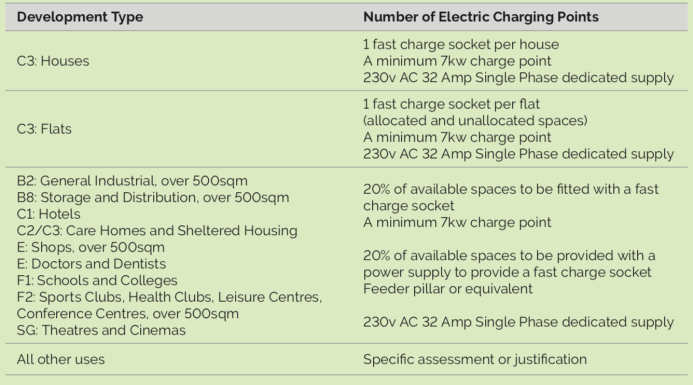
- Expect larger developments to have considered mobility hubs (central area for electric charging, cycle sharing and car clubs) with the evolution of a scheme design.
Climate Change Adaptation
3. To ensure that the District is future proofed for climate change, the Council will expect all development (including the conversion of existing buildings) to, where practicable and with reference to local character:
- Adopt passive design principles, including orientation, glazing and shading with regard to the winter and summer sun and zero energy or low energy ventilation;
- Minimise resource use, during construction and post-construction, to achieve the maximum possible Standard Assessment Procedure score (see also Policy H10);
- Reuse construction waste on site or arrange for the waste to be reused or recycled;
- Incorporate sustainable drainage systems, such as green roofs, green walls, rainwater harvesting, permeable paving, rainwater gardens, swales, reed beds and treatment and balancing ponds;
- Retain and/or provide soft landscaping to create natural cooling measures, biodiversity habitats or local food growing. The soft landscaping should have reference to native species and local character (see also Policy EN8); and,
- Install community composting facilities, where practicable.
For more information please see the Mole Valley Local Plan